Questão 22
(UNESP - 2021 - 1ª fase - DIA 2)
Leia o texto para responder às questões de 21 a 24.
When will the Amazon hit a tipping point?
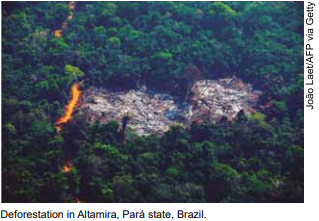
Scientists say climate change, deforestation and fires could cause the world’s largest rainforest to dry out. The big question is how soon that might happen. Seen from a monitoring tower above the treetops near Manaus, in the Brazilian Amazon, the rainforest canopy stretches to the horizon as an endless sea of green. It looks like a rich and healthy ecosystem, but appearances are deceiving. This rainforest — which holds 16,000 separate tree species — is slowly drying out.
Over the past century, the average temperature in the forest has risen by 1-1.5 o C. In some parts, the dry season has expanded during the past 50 years, from four months to almost five. Severe droughts have hit three times since 2005. That’s all driving a shift in vegetation. In 2018, a study reported that trees that do best in moist conditions, such as tropical legumes from the genus Inga, are dying. Those adapted to drier climes, such as the Brazil nut tree (Bertholletia excelsa), are thriving.
At the same time, large parts of the Amazon, the world’s largest rainforest, are being cut down and burnt. Tree clearing has already shrunk the forest by around 15% from its 1970s extent of more than 6 million square kilometres; in Brazil, which contains more than half the forest, more than 19% has disappeared. Last year, deforestation in Brazil spiked by around 30% to almost 10,000 km2 , the largest loss in a decade. And in August 2019, videos of wildfires in the Amazon made international headlines. The number of fires that month was the highest for any August since an extreme drought in 2010.
(www.nature.com, 25.02.2020. Adaptado.)
According to the second paragraph, a change in vegetation can be noticed by
the expansion of trees adapted to drier climate conditions.
the reduction of nut tree population hit by three severe droughts.
adaptation of vegetable species to longer months of dry season.
alteration of tree locations, like growing closer to rivers.
substantial decrease of Inga and Brazil nut trees.
Gabarito:
the expansion of trees adapted to drier climate conditions.
Resolução:
a) Alternativa correta. É possível observar isso em "trees that do best in moist conditions, such as tropical legumes from the genus Inga, are dying. Those adapted to drier climes, such as the Brazil nut tree (Bertholletia excelsa), are thriving".
b) Alternativa incorreta. A população da Brazil nut tree está, na verdade, crescendo.
c) Alternativa incorreta. Não há a adaptação das espécies para resistirem a meses sem chuva, mas sim a sobrevivência de espécies mais resistentes a climas mais secos.
d) Alternativa incorreta. O texto não cita a mudança de local de crescimento das árvores.
e) Alternativa incorreta. As plantas do gênero Inga estão realmente morrendo, mas as Brazil nut trees estão vingando.