Questão 22
(UNESP - 2022 - 1ª fase - DIA 2)
Leia o texto para responder às questões de 21 a 27.
Water and Urbanization
Urban areas are expected to absorb all of the world’s population growth over the next four decades, as well as accommodating significant rural-to-urban migration. The vast majority of these people will be living in overcrowded slums with inadequate, often non-existent, water and sanitation services.
Safe drinking water systems and adequate sanitation that effectively disposes of human waste will be essential to ensure cities and towns grow sustainably. Extending these services to the millions of urbanites currently unserved will play a key role in underpinning the health and security of cities, protecting economies and ecosystems and minimising the risk of pandemics.
For the first time in history, more than half of the global population live in towns and cities. By 2050, that proportion is expected to rise to two-thirds. Population growth is happening fastest in urban areas of less developed regions, with the urban population estimated to grow from 3.9 billion people today to 6.3 billion in 2050.
Even though water and sanitation access rates are generally higher in urban areas than rural, planning and infrastructure have been unable to keep pace in many regions. Today, 700 million urbanites live without improved sanitation, contributing to poor health conditions and heavy pollution loads in wastewater, and 156 million live without improved water sources.
However, cities provide significant opportunities for more integrated and sustainable water use and waste management. The positive impacts of these services, particularly for public health, spread rapidly and cost-effectively among densely populated unplanned settlements. Furthermore, more efficient use of water within cities and the safe reuse of more waste will put less strain on the surrounding ecosystems.
(www.unwater.org. Adaptado.)
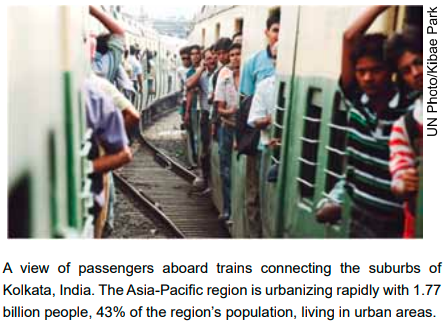
A fotografia e sua legenda ilustram o trecho do texto:
“700 million urbanites live without improved sanitation” (4º parágrafo).
“Population growth is happening fastest in urban areas of less developed regions” (3º parágrafo).
“The vast majority of these people will be living in overcrowded slums” (1º parágrafo).
“For the first time in history, more than half of the global population live in towns and cities” (3º parágrafo).
“water and sanitation access rates are generally higher in urban areas than rural” (4º parágrafo).
Gabarito:
“Population growth is happening fastest in urban areas of less developed regions” (3º parágrafo).
Resolução:
A imagem mostra uma grande concentração de pessoas em um trem, e sua legenda nos informa que se trata de um trem na Índia, além de que na região pacífico-asiática há 1.77 bilhões de pessoas, isto é, 43% da população da região, vivendo em áreas urbanas. Tais informações deixam claro que a frase que melhor se relaciona com a imagem é a da alternativa B, "o crescimento populacional está acontecendo mais rapidamente em áreas urbanas de regiões menos desenvolvidas".